What is an Airport City?
In today’s world, airports have evolved beyond mere air transport hubs, becoming multimodal transportation centers and platforms for the development of various industries and businesses. The growth and economic impact of airports are determined based on national development goals, local economic dimensions, competition with domestic and international rivals, and regional and transregional connectivity.
The concept of an “Airport City” and “Aerotropolis” was introduced and developed years ago by Dr. John D. Kasarda, a professor and theorist. According to this concept, an airport city is a specific area where the airport forms the core and various businesses, including aviation services, logistics industries, and other commercial enterprises, develop around it. In other words, airport cities go beyond conventional air transportation services (passenger and cargo terminals, airside (flight levels) and related services) and incorporate infrastructure and economic projects centered around the airport. These cities offer diverse business opportunities in logistics, administration, hospitality, entertainment, commerce, industry, services, and retail, making them unique economic zones.
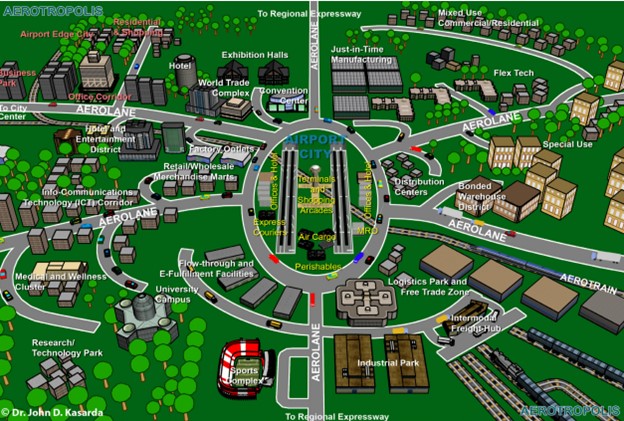
Imam Khomeini Airport or Imam Khomeini Airport City? That is the Question!
Considering that, in addition to air transportation services, 1,500 hectares of land in Imam Khomeini Airport City (IKAC) have been designated as a free trade zone and another 2,500 hectares as a special economic zone and given the wide range of investment opportunities and diverse businesses available within the airport city’s area, the “airport” itself represents only a small portion of “Imam Khomeini Airport City.”
With its development phases, the total aviation zone spans approximately 4,000 hectares, while an additional 10,000 hectares are allocated to other services and activities within the airport city.
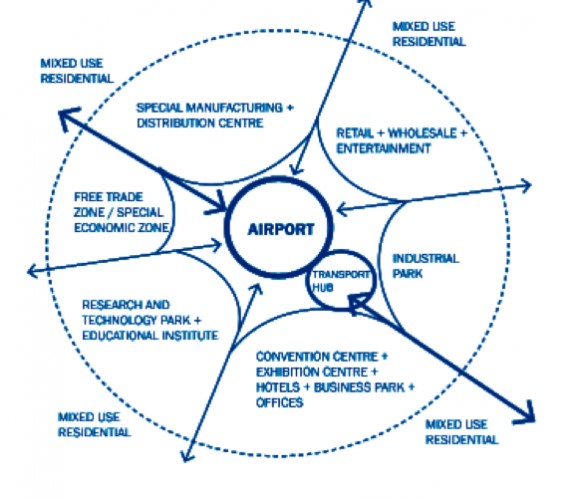
Imam Khomeini Airport City
Imam Khomeini Airport City is located in the southwestern part of the Tehran metropolitan area. With a regional population of approximately 14 million in Tehran Province, 90 million in Iran and 400 million in the international transit radius, the airport city is strategically positioned and has access to numerous manufacturing plants that supply various industries. Additionally, the presence of industrial zones and complexes around the airport city and the outskirts of Tehran provides advantages such as workforce concentration, knowledge sharing, supplier accessibility and enhanced social interactions. Imam Khomeini Airport City, positioned at the intersection of major rail and road networks and centered around the airport, offers an ideal location for trade development.